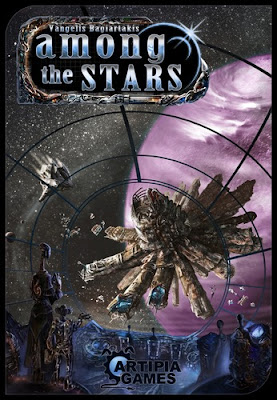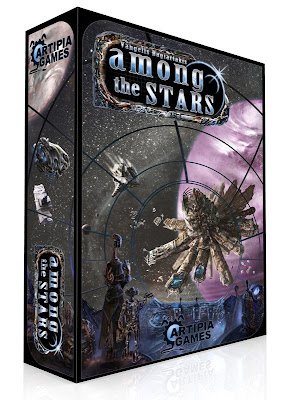

scritto da Iziosbiribizio


La versione aggressiva comporta l’aggiunta delle carte conflitto, grazie alle quali per l’esiguo costo di un credito è possibile infastidire gli avversari. Leggendo i commenti su bgg mi è saltato all’occhio il commento che diceva “ecco il gioco che sostituirà 7 wonders“, il che fa capire che la somiglianza non è solo un’opinione.


Hi Vangelis and thx to be here with us. I remind to our readers that
you’re the author of Souvlaki Wars, a game we talked about last year.
Now I see that another game is being published: can you tell us
something about the story of Among the Stars (how it was developed and
published) ?
About 2 years ago I was asked by some friends working in a christian
organization to design a game to be given for free to the children of
the Sunday schools. The comments I received about it when it was
finished, were very positive and I decided to take its core mechanics,
work some more on it and design a new game that could be commercially
published. Konstantinos Kokkinis (the owner of Artipia Games) played the
game, liked it a lot and decided to publish it in 2012. Thus, “Among
the Stars” was born.
Ok, now let’s give a look at the game: it’s a mix between a
tile placement and a card game, everithing merged into a sci fi theme.
Do you believe that the connection between the background story and the
game theme is strong ?
 The main mechanism of the game is the card drafting so that’s
how I would probably describe it, a card-drafting game. Of course, where
you place the card you draft each turn is very important, so that’s
where the “tile-placement” comes in. Now, as far as the theme is
concerned: I happen to love science fiction so very early on I decided
to have the game be about building a Space Station. Not like the one
NASA builds but more like Babylon 5 or Deep Space Nine. From that point,
that particular theme was what drove most of my decisions. I came up
with a list of locations (that one would find in such a space station)
and for each of them I tried to come up with an ability that would fit
theme-wise. For example, since the crew quarters are usually all
together in a section of the station, I made their location cards give a
bonus if placed next to each other. The Fighter Launch Bay on the other
hand is a location that should be build in the outer parts of the
station. It’s ability reflects that, forbidding you to build it near the
“centre” of your station. I went through that process for all the
location cards in the game. On top of that, every location “type” has
its own unique “feel”. The business locations for example mostly have
abilities that are about credits while the diplomatic locations are all
about interaction with the other players. Finally, the alien races that
the players choose to play as, have different abilities and each one is
tied to that race’s thematic background story (which you can read in the
manual). So, an aggressive race has an ability that lets it take cards
from other players’ hands, a race with a planet rich on resources starts
every round with more credits than the others, and so on.
As you can see, the theme is heavily integrated in the game and it played a huge role during its design.
What’s the target audience for this game: core gamers or family gamers ?
The
good thing with Among the Stars is that it can be played in many
different ways. When you introduce it to new players you can play
without races, objectives or conflict cards and the game can be
explained in less than 5 minutes. This makes it easy for everyone to
play their first game, regardless of their experience or their
preference in heavy/light games. The full game on the other hand (where
all that I mentioned above are included) is slightly more complicated,
but offers additional options and may appeal more to core gamers.
 Are the resource management mechanics strong ? And about the interaction ?
The
players have basically 2 types of resources to manage. One is their
credits (of which they get 10 each round but are rarely enough) and the
other is energy for which they must build power reactors. The key to
playing correctly is to make sure you don’t get passed a card you need
but are left without resources to build it. It sounds simple (and
needless to say perhaps) but it turns out to be harder than it seems.
There will be times where deciding between to play a card or discard it
to get credits for example will make all the difference in the game.
As far as the interaction is concerned, I am a firm believer that a
“draft” incorporates in it a lot of interaction. It may be subtle and
not that direct, but it is there and players MUST take into
consideration what the other players are doing if they want to do well.
However, in Among the Stars there are also many cases of direct
interaction, like the diplomatic locations that I mentioned before which
interact with the other players and create interesting situations.
Moreover there are also the so-called “conflict cards” that you can put
in the game if you want to add even more direct confrontation between
the players.
Izio, who wrote the short preview about the game you had the
chance to read, did not appreciate the fact that the game mechanics
seems to be too similar to the ones seen in 7 Wonders and Glen More.
Here you’re free to deal with this matter and to reply to him 😉
Let me start by saying that I have never played Glen More nor have I
read its rules or seen someone play it. So, if there are similarities
with it, they are purely coincidental. As for the 7 Wonders, yes the
drafting mechanism is similar (and that’s why many comparisons are made
to it) but other than that the 2 games are quite different. The thing is
that just by reading the manual, it’s easy to come to the conclusion
that the two games are similar. However, when you look at the cards
(and especially when you try to use their abilities in a game) you
realize that the rules only give you a small glimpse to how the game
really plays. The most characteristic example is that of a friend of
mine who ended up as one of the main playtesters. He is a heavy gamer
and when he read the rules, his first reaction was “that’s it?” – it was
clear he wasn’t impressed. A few plays in though, he became addicted to
the game. He ended up discovering new strategies, formulating different
plans to victory, analyzing optimal plays etc, realizing that there is a
lot of depth and strategy in the game. And there were similar reactions
from our indiegogo campaign supporters too, who got to play the game in
print-and-play form.
So, as soon as Izio tries the game himself, I’m pretty confident that his opinion will also change! 🙂
 Ok, now you’ve a free space di advertise the game 😉 Why should we buy it ?
Because it is a game you are going to enjoy a lot! Simple as that! 🙂
Of course, this is what every designer says about his game, so it
may not be enough to persuade you. Here are then some other reasons,
more “objective” if you like:
– Easy to learn
– Plays quickly
– High replayability
– Allows for various strategies and requires a lot of “tough decisions” during play
– Can be played in various ways (ie aggressive/non-aggressive)
– Appeals to both casual and core gamers
– AMAZING artwork
– Cool theme
– AMAZING artwork (did I mention that?)
– The designer is a nice guy
Are these good enough reasons for you? 🙂
Other projects you’re working on ?
I am currently working on a game for Kaissa, a boardgame company here in
Greece (the one that did my previous game, Souvlaki Wars). It will be a
Mafia/Werewolf variant for 7-20 players and it is planned for early
2013.
Se ti va di sostenerci, puoi fare i tuoi acquisti su DungeonDice.it